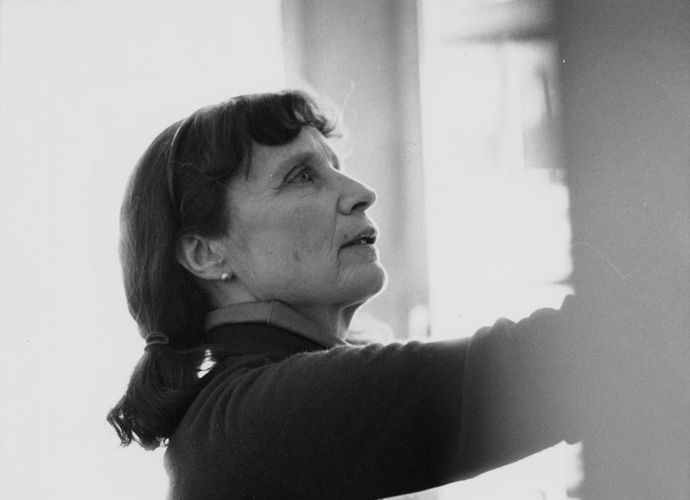
Emily Mason
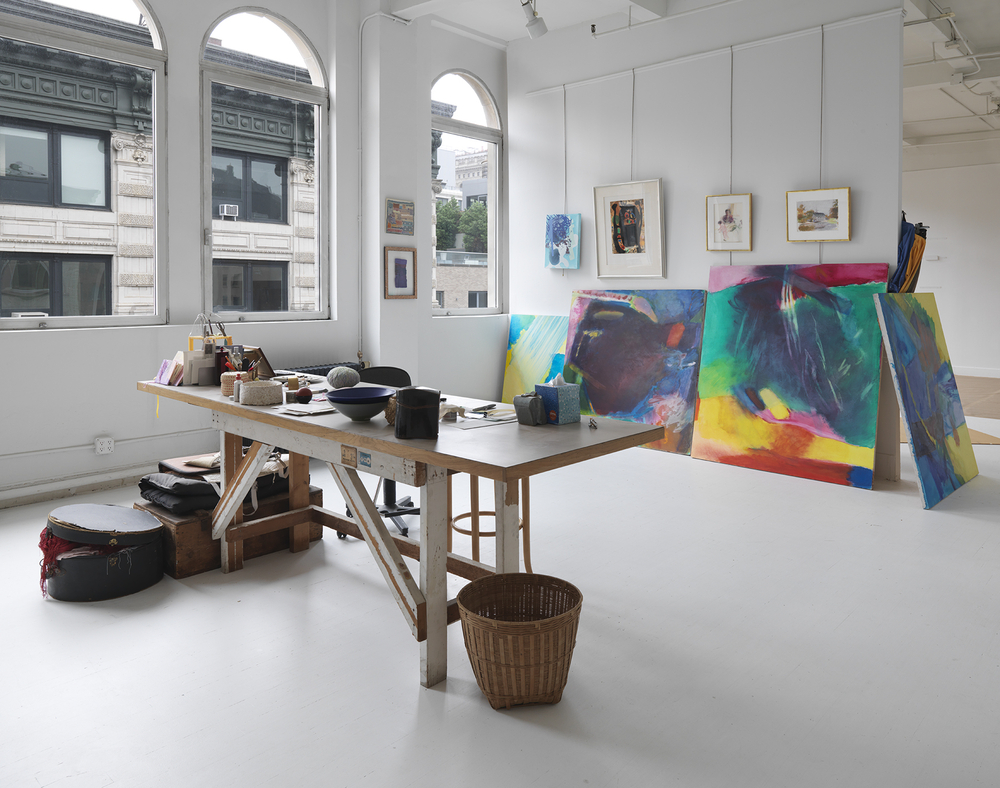
Northeast view of Emily Mason’s New York Studio.
(image courtesy the Emily Mason and Alice Trumbull Mason Foundation and Miles McEnery Gallery; photo by Christopher Burke Studio)
The storage racks in Mason’s studio — which is still exactly as she left it, down to the slippers and a January 2019 copy of the New York Times lining the work table — are packed with paintings from this mid-career period. It represents a moment before she hit her commercial stride, but was steadily cranking away in her studio. Today these are the bulk of her unsold inventory, after galleries eventually found buyers for her later works.
“These paintings are very flat but she would either add a bit of articulation that would come off the surface, or she would mine it and pull back using [turpentine] and a rag, or a scraper, to almost illuminate by subtraction,” notes Rose, pointing to “Untitled” (1984) which features rough pink brushwork on the left, balanced by thinned-out blue planes on the right. Other paintings are harder to decipher, with one of the hallmarks of a Mason painting being that you can’t tell which layer is on the bottom and which is on top.
Mason hatched other tricks, too. In works like Untitled (“Vermont”), there are feathery veins of paint and uneven pigment goosebumps. When asked how Mason created such effects, Rose acknowledged to Hyperallergic that he still doesn’t know. “Emily would always mischievously giggle and say, ‘I’m not sure. Magic, I think.’ She was really coy about it.”
Mason started many of these works in Vermont, where she and Kahn had a country home and spent every summer for around 50 years. “I work better in Vermont than I do in New York,” Mason explained in a short 2017 documentary about her painting practice. Her Vermont studio was in a former chicken coop, overlooking a frog pond instead of skyscrapers.
But no matter where she started a painting, Mason’s expansive Chelsea studio became her tuning fork — the barometer she used to check that colors and shapes were humming at the right frequency. “These are all things that are gonna be reassessed in New York,” she remarks in the documentary, in a scene where she’s packing up her Vermont studio to return to Manhattan. It’s the candid admission of a seasoned painter who relied on a specific workspace for its north-facing light, and maybe also for its precious solitude. After a thoughtful pause Mason adds, “I really won’t know what these look like until I get them back in the city.”
Emily Mason: Chelsea Paintings continues at Miles McEnery Gallery (520 West 21st Street, Chelsea, Manhattan) through February 13.
Karen Chernick —
